
A blog inspred by the second week of Calling a Wounded Earth Home, a Lent Course produced by Green Christian. You can read the first post in this series at this link.
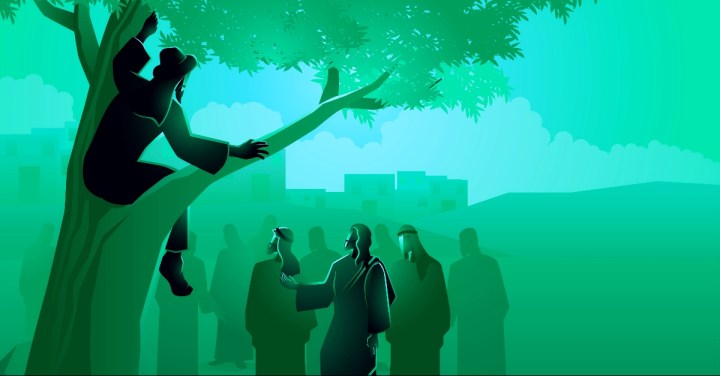
I’ve always read the story of Zacchaeus as a simple story of a repentant sinner. This week’s Bible study has made me think about it in a different light. The clue to this change of understanding has been the recognition that it is unique to Luke’s gospel which has led me to re-read some of the other verses that are also unique to Luke.
If you do this Luke’s revolutionary side really emerges. It is only Luke who attributes revolutionary thoughts and words to Mary:
1:52 He has brought down rulers from their throne
but has lifted up the humble.
53 He has filled the hungry with good things
but has sent the rich away empty.
It is only Luke that remembers Jesus’ first sermon as announcing that
4:18 The Spirit of the Lord is on me,
because he has anointed me
to proclaim good news to the poor
He has sent me to proclaim freedom for the prisoners
and recovery of sight for the blind,
to set the oppressed free,
19 to proclaim the year of the Lord’s favour.
Luke’s beatitudes are more earthy than Matthew’s and, uniquely, he follows these with a series of woes which remind us that not only will the poor and hungry be blessed, but that the rich and satiated will be cursed:
6:24 But woe to you who are rich, for you have already received your comfort.
25 Woe to you who are well fed now, for you will go hungry.
Read in this context we recognise that Zacchaeus is not presented as a repentant sinner but as a convicted thief. When he promises to pay back four times what he took he is paying the punishment for theft as required in Exodus:
22:1 When someone steals an ox or a sheep and slaughters it or sells it,
the thief shall pay five oxen for an ox and four sheep for a sheep.
What’s more he is paying the full price for someone who steals and slaughters rather than the lesser penalty for a simple theft:
22:4 When the animal, whether ox or donkey or sheep, is found alive in the thief’s possession, the thief shall pay double.
or the even more lenient punishment outlined in Leviticus for the thief who admits his own guilt:
2 If anyone sins … through robbery … 4 and has realized his guilt and will restore what he took by robbery … 5 he shall restore it in full and shall add a fifth to it.
Zacchaeus is representative of the “rich who have been sent away empty”, or who “have already received their comfort”. His payment of the appropriate reparation is “good news for the poor”. It is evidence of the Kingdom breaking out in that time and in that place, on earth as it is in heaven or as Luke remembers Jesus saying, “Today, Salvation has come to this house”.
The study material asked, “What would Zacchaeus do in response to the climate crisis?”, and by implication what should we do. The question forces us to acknowledge that we in the Global North are both rich and guilty of theft. The richest 10% of the world are responsible for nearly half of global emissions each year whilst. The poorest 50%, mostly in the Global South, are only responsible for abut 10% yet are those most affected by the impacts of climate change (Oxfam). The two maps below are coloured to represent the countries responsible for the greatest emissions since the industrial revolution (left) and those that are most vulnerable to climate change (right). You can see that they are very nearly inverted images of one another. Those who have done least to cause the problem and those who are suffering the most form its effects.
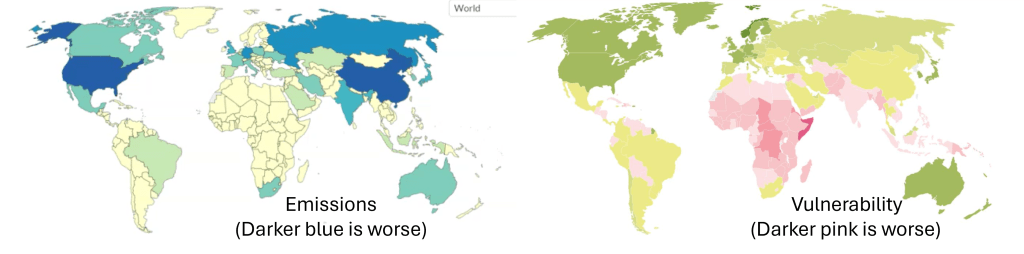
What would Zacchaeus do? He would acknowledge his crime and pay reparations of four times the original theft. What do we do? The UK government has recently admitted that it is reducing its contributions to international climate funds by 40% (after the effects of inflation have been accounted for). No sign of the Kingdom breaking through in this place and this time.
 Large Blue