
A sermon exploring how we should respond to the loss of diversity in our world
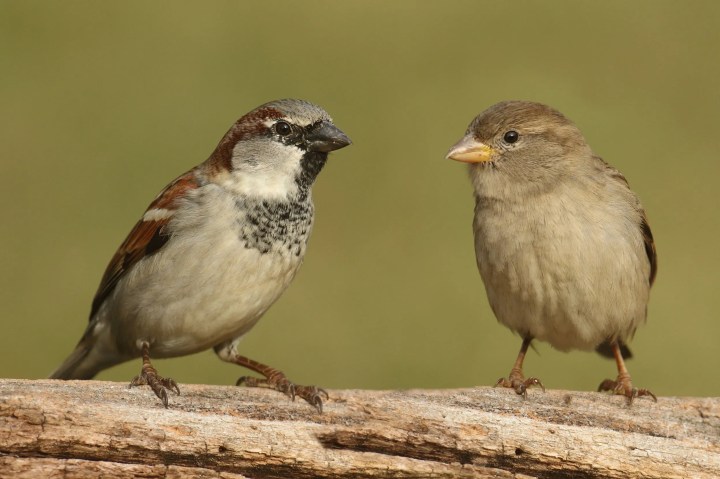
This sermon was preached on the weekend of the RSPB’s Great British Garden Birdwatch. Earlier in the service we had reflected on government statisics of how bird numbers have dropped over the last fifty years. Numbers of typical farmland birds including the house sparrow, which is the consistently most commonly observed species during the birdwatch, have deteriorated by about 60% over that period.
Earlier in our service we had had a prayer of lamentation to express our grief for what is happening and sung my hymn “Singing our vision” which asks “How can our voices save God’screation?”.
The sermon is based on the passage (Matthew 6:25-34) from the Sermon on the Mount when Jesus comments on how God feeds the “birds of the air”.
I find that preaching about some of the problems that we face in our modern world can be really challenging. When I preach, I want to preach from the Bible, but the Bible was written a long time ago and the world has changed significantly since it was written. The are some areas in which the world is so different that we cannot expect to find any direct answers in texts written so long ago.
The loss of biodiversity in our modern world is one of them. It can never have occurred to anyone writing or thinking before the industrial revolution, that humans would ever develop technologies that were capable of destroying the natural world. For most of human history our ability to change the ecosystems in which we live has been minimal. This is reflected in all of the Biblical passages about creation. Nature is presented as something that is enormous and wonderful but completely beyond human understanding or influence.
Since the dawn of mechanisation and industrialisation this has reversed. It seems that nature is diminishing in size as a result of human progress. It is very clear that humanity can influence the natural world and indeed that currently this influence is extremely damaging. This requires a world view completely different to that of the ancient societies in which the Bible was written, and it shouldn’t surprise us that the Bible really has very little to offer us directly about how we should respond to this particular aspect of the world in which we live.
I normally choose Bible readings to help us in our thinking, but I’ve actually chosen one today to illustrate this difficulty. The passage about the birds of the air and the lilies of the field is a one with which we are very familiar. Its primary point is to tell us not to worry which is great, but the logic on which it is based seems fatally flawed given what we know about the world today.
“Look at the birds of the air; they do not sow or reap or store away in barns, and yet your heavenly Father feeds them.”
Do we really believe that God feeds the birds of the air? Most of us were taught at school or through nature documentaries about food chains in which one species feeds on another species which in turn feeds on another. Any of you who have been particularly attentive will know that today we tend to talk more about food webs with more complex interactions between species. If food is abundant, as last autumn when there was a huge glut of acorns, then the species that feed on them will grow in numbers, which explains the huge number of squirrels in our garden this winter. If food becomes scarce then those numbers will die back. We understand the process without having to assume that God is micromanaging it in anyway or indeed without any evidence that God is intervening at all.
If we continue to insist that God is ultimately responsible for feeding the birds, then we run into problems when we look at the modern world. Many of our insect eating birds have fallen catastrophically in numbers over our lifetimes. House sparrows are a classic example. Numbers have fallen by over two thirds since 1995 and the species is now on the red list of endangered species within Britain. Some of that loss has been blamed on a lack of breeding sites but almost certainly the most important factor is the equally dramatic fall in the availability of food. If God is responsible for feeding them then God is failing in God’s task.
Given what I understand about the natural world I find it impossible to believe in a God that is responsible for feeding wild birds. Wild birds eat what ecosystems provide for them and if humans destroy or diminish those ecosystems then those birds will have nothing to eat. In a world in which humans dominate the environment it is humans who are responsible for ensuring that sufficient food remains available for the birds, not God. Unless we reject ancient pre-scientific views about how God is in control of the natural world then the Bible will become a stumbling block rather than bringing a message of hope.
So how can our faith help us? We need to move away for scouring the Bible for specific texts that relate to particular aspects of our modern world. Even if we find them, we will almost certainly have taken them out of context and run the risk of serious misrepresentation of the Gospel. Instead, we need to look at the big picture. We need to look for big over-arching themes that the Bible presents us with and apply this general understanding to the specifics of the world in which we live.
The place I would start in relation to the destruction of the environment is with the lamentation of the Old Testament prophets. In all sorts of situations, the prophets saw that human, particularly the ruling classes, were not doing what God wanted and that this was leading to destruction. In their worldview they saw this as a result of God punishing them for their acts but in a scientific age, we see that this is often a direct consequence of the acts themselves. The first reaction was an expression of horror and grief that this was happening that we call lamentation. There is a whole book in the Hebrew Bible called Lamentation and devoted to expressing this horror and grief. There are extensive passages of Lamentation throughout the writings of the prophets including, but not limited to Isaiah, Jeremaih, Amos and Hosea. There are more psalms of lament than there are of praise and thanksgiving. If the Book of Psalms is the hymn book of the early Jewish community, then it is clear that they spent a considerable amount of time lamenting for the state of the world.
It is something that Christianity has lost. We often get so focussed on praising a good God that we forget that there are aspects of this world, and particularly of human behaviour, that are very far from good. When we do reflect on human behaviour we tend to focus on the sins of individuals whereas it is the structural sinfulness that is intrinsic within our society that is the real problem. If Christianity is to be relevant to the modern world it has to rediscover the ability to lament. The ability to look at what is happening within our world and call out in horror and grief, “this is not what God wants”. This is what we did when we paused this morning to reflect, in grief, on how we are allowing our wild bird populations to plummet.
This is important because it is only when we acknowledge the problems of our current world and how they stem from our societal behaviours that we can start to imagine a different world. The prophetic imagination is one of the greatest gifts to the world that has been given by any early society. The prophetic imagination, exemplified by Isaiah, by Amos, by Hosea, by Micah. Was to see a world in which humanity was failing and to imagine that it could be different. To imagine in a world that turned itself from God’s will and brought destruction that we could turn back to God’s will and bring about abundance.
We as Christians need to inherit that prophetic imagination. We need, above anything else, to look at today’s world in horror and grief, with lamentation, but to imagine that it can be different. That is where Christian hope starts.
Jesus when he looked at the world in which he lived saw all its failings, he lamented. We remember that when he entered into Jerusalem on that first Palm Sunday, in the middle of all that celebration, he broke down and wept for a suffering world. But he had the imagination to see that the world could be different. He imagined a vision of a Kingdom of God, on earth as it is in heaven. Let’s savour that sentence, a Kingdom that is not remote, in the future and otherworldly, a Kingdom that is close, that can be here and now.
And what did he do? He preached about that imagined Kingdom to anyone that would listen. He told the truth even when it brought him into conflict with the ruling classes. He continued to tell the truth and present his vision even when that conflict threatened him with persecution and even execution. He continued to tell the truth and present his vision even from the cross itself, “Forgive them, for they no not what they do?” Jesus had the confidence that the truth of his words and the power of his imagination would triumph, whatever the worldly authorities could do to his body.
Above all, in the modern world we as Christians are called to proclaim that things can be different. We are called to lament for a world that is failing and progressing towards destruction but also to imagine a world that is different, that is better. We are called to present that vision to a wider world in the confidence that that vision will triumph eventually whatever happens to us as individuals. We are called to proclaim a vision of God’s Kingdom as it affects every aspect of our lives. But this morning let us proclaim a vision of a natural world that is cherished, valued and restored. Let’s proclaim that vision in our worship this morning but let us also proclaim that vision to everyone we meet. Why not spend a little time this week imaging how this world could be different, better, and sharing that vision with one other person. It is only when we, as a society, can imagine a world that is better than the one in which we live, that we, as society, can have any hope of bringing that world into reality. It is only when we, as a society can imagine the Kingdom of God, that we as society, can have any hope of making that Kingdom a reality.
 Large Blue