
The eighth in a series of posts on common but differentiated responsibilities. You can read the first here.
In matters of climate justice, as in any other form of justice, whether a particular approach appears just often depends on the viewpoint from which you are looking. The convergence and contraction model I outlined in an earlier post is good example. If we assume that all that matters is how the world is today, then a policy that allocates the carbon budget remaining to limit temperature rises to those agreed at the Paris Climate Convention to countries on the basis of their population appears just. On the other hand if we acknowledge that the world as it is today is a consequence of how it has developed over the last two hundred years, then a different perspective emerges.
From this perspective, the carbon budget should not be that remaining from today, but that calculated from a pre-industrial baseline, and the allocation of future emission targets should include a consideration of historical emissions. The most recent IPCC Assessment Report gives a total budget (since 179o) to limit temperature rises to 1.7°C as 3,240 gigatonnes (Table SPM.2). Data from another source can be used to calculate the emissions that have already been emitted by the the developed1 and other countries (as originally specified in the UNFCCC). The left-hand pie chart below shows that emissions so far amount to 78% of the total budget and that the developed countries have emitted considerably more (47%) than the others (31%). 22% is so far unused.
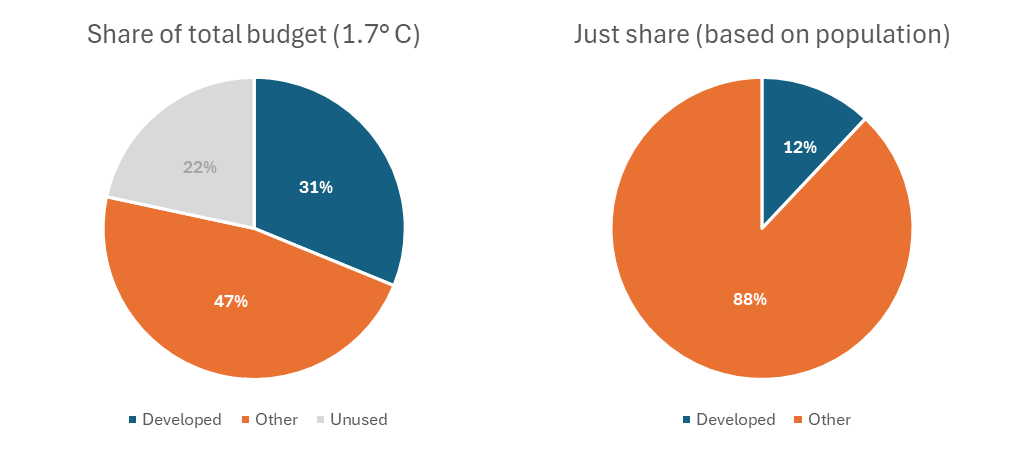
If we assume a just allocation of the total budget is an equal share for each person then the just share will reflect the total population in the developed and other countries. This is 12% for the developed countries and 88% for the others as depicted in the right-hand pie chart. On this basis the developed countries have already used 2.5 times more of the total budget than they are entitled to.
Of course no-one set out to cause global warning. It can be argued that accountability for historical emissions should be limited to the time at which their link to global warming was first established. If we take the publication of the first IPCC report in 1990 as the baseline and repeat the calculation we get a very similar result. However you look at it, the developed countries have already used up substantially more of historical carbon budgets than they are entitled to.
The convergence and contraction model, which at first appeared to represent a just approach, thus seems very far from one. On the other hand, insisting that the developed countries have already emitted too much carbon dioxide and must stop emitting immediately is not possible, either politically or technically. It might be that the convergence and contraction model is the most just approach that we can hope for in a real world, even if it does allowed the developed countries to evade their historical responsibilities.
- Although the division of the world into developing and developed countries is generally regarded as outdated, the terms will be used here as they are those used in much of the historical literature on which these posts are based. ↩︎
 Large Blue